Pages

For Criticize and Suggestion, E-mail : exploreindonesiablog@yahoo.com or write it @ C-BOX
Showing posts with label Batik. Show all posts

21 October 2010

UKM Gallery: Preserving The Indonesian Heritage


Jakarta as a barometer of cities in Indonesia, currently has a new shopping destination that offers high quality  products made by Indonesia's finest suppliers, namely UKM Gallery in SMESCO Building, South Jakarta. It sales many wonderful craft products, such as Batik Tulis from many regions, Padang and Palembang's Kain Songket, Nusa Tenggara's Kain Tenun, many beautiful handicrafts, furnitures, a wide range of carefully selected jewellery and accessories fashioned on the latest styles, including all-natural international spa kits.

Opened on 3 April 2009 by The Minister of Cooperatives Small and Medium Enterprises, it sells diverse works of the talented craftsperson nationwide with competitive price in its UKM Gallery retail outlet occupying 3 floors of the main building of SMESCO UKM.


The products here are made by Indonesian craftsmen with the best quality and some of these products are exported to several countries. The mission of UKM Gallery is to promote cultural heritage of Indonesia by introducing high quality Indonesian products not only to Indonesians, but also the world.

Contacts:
UKM GALLERY
SMESCO UKM Main Building, G-3rd Floor
Jl. Jend. Gatot Subroto Kav.94 Jakarta 12780 - Indonesia
Phone: 62.21 2753 5400 (Hunting), Fax: 62.21 7919 4628
mailto : info@smescoindonesia.com
www.smescoindonesia.com


20 April 2010

Batik: "Writing A Point"

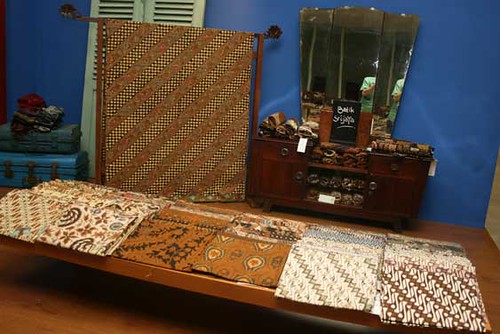
Batik is a craft that has high artistic value and has become part of Indonesian culture (especially Java) since long. Javanese women in the past to make their skills in batik making a livelihood, so that in the past, batik work is exclusively women's work until the invention of "Batik Cap" which allows the entry of men into the field. There are some exceptions to this phenomenon, namely the coastal batik which has a line of masculine as can be seen in the style of "Mega Overcast", which in some coastal areas is a common job for women making batik batik lelaki.Beberapa can show the status of a person. Even today, some traditional batik are only used by families of the palace of Yogyakarta and Surakarta.

History
This art of batik in Indonesia has been known since the days of work and developing the Majapahit kingdom and the kings of the next. Batik art became more widespread and particularly the people of Indonesia especially Javanese people after the end of eighteenth century and early nineteenth century. Produced batik batik is all until the early twentieth century and printed batik is known only after the world wars or the unity out around 1920. The connection with the spread of Islamic teachings. Many areas in Java batik centers are areas Batik students and then become a tool of economic perjaungan by figures pedangan Muslims against the Dutch economy. The word "batik" is derived from the combination of two words in Javanese: "Amba", which means "writing" and "point" which means "point".


How to Make
Batik originally made on material with white color made of cotton cloth called. Today batik is also made on other materials such as silk, polyester, rayon and other synthetic materials. Batik pattern is formed with a liquid wax using a tool called a canting for subtle motifs, or large-sized brush for a motive, so that the liquid wax to seep into the fabric fibers. Fabrics that have been painted with wax and then dyed with the desired color, usually starting from the colors of young. Immersion then taken to another motif with older or dark colors. After some time the coloring process, which has dibatik cloth dipped in chemicals to dissolve the wax.

Types of Batik
Batik Solo


Batik Cirebon


Batik Buketan - Pekalongan


Batik Madura

 
Indonesian batik, as the overall engineering, technology, and development-related motives and culture, has been designated as Masterpieces of the Oral and Intangible Heritage of Humanity by UNESCO since October 2, 2009.

02 November 2009

Solo - The Largest Batik Producer

Solo is ranked the tenth largest city (after the Yogyakarta). The east side of town impassable river in one of the songs keroncong, Bengawan Solo. This city was also the seat of the prefect, in charge of the residency of Solo in the early days of independence. Resident office is now abolished and replaced by a "assistant governor for the region of Solo". Solo has the motto of which is an acronym beam of Clean, Healthy, Neat, and Beautiful. For the purposes of tourism marketing, tourism slogan Solo Solo took the Spirit of Java that is expected to build the image of the city of Solo as a center of Javanese culture.


Regional languages used in Solo is a dialect of Javanese Solo. These dialects differ slightly Javanese dialect used in other cities such as Semarang and Surabaya. The difference of vocabulary used, ngoko (rough)-conduct (smooth), and intonation. Java language of Surakarta is used as the standard Java language national (and international, as in Suriname).

Solo is a residential area for workers or the perpetrators of economic activity in the region of Solo City. New Solo there are many moderate and luxury housing, therefore New Solo is an elite residential area. New Solo also have Carrefour supermarket. Pandavas waterboom which is the largest in Central Java and Yogyakarta have in this area. Although included in Sukoharjo District but economically and politically New Solo closer to the city of Surakarta, because the location of the town area which directly borders the city of Surakarta, ever even discourse about regional integration in suburban areas around New Solo Surakarta including to put in territory. The total area of Surakarta City and town areas currently supporting approximately 150 km ² with a population of about 1 million people


The Largest Batik Producer


Solo's is one of the famous batik producer and batik shopping centre in Indonesia. Here there are many centers of batik cloth, which is famous among other Laweyan Batik Village area and the area Kauman Batik Village. Batik Tourism Village is one of the products and has become a city icon batik solo .Batik already known in Indonesia and became the main product export.

Solo Batik is famous for its traditional style and patterns in the process of batik and the batik stamp he wrote. The materials used for coloring is still a lot of wear materials such as Soga domestic well-known Java since the first. The pattern remained among others known as "Sidomukti" and "Sidoluruh".

Laweyan Batik Village

Laweyan is one of production, and shopping centers in the city of batik solo.In this village there are a lot of history behind this village became icon Batik Solo.
Batik is a traditional art works that many people studied the about Batik Producing. Since the 19th century, this village was known as batik village. That is why the village Laweyan village once known as batik masters who achieved glory at the age of 70 years.Now, Batik Solo has been exported to other country in the world


Shopping centre


Solo is a great city for shopping.In Solo there are two modern shopping centers, namely Solo Grand Mall and Square. Unless you need some clothes or snacks.It is precisely the need to visit the traditional markets. Klewer Market is the first order for you to shop by special Gifts from Solo, namely batik. Located on the north plaza right across from the Grand Mosque of Surakarta and just a stone's throw away to the palace, Klewer market provides a variety of batik patterns and applications. In addition to fabric and shirts are common, there is also a gown, gloves, or a pillowcase. The price depends on your bargaining skills. As an illustration, a piece of batik cloth in Jakarta at less cost Rp 250.000,00 ( US$25 ) here can be obtained with only one tenth! Skill Madyo Java language is required to obtain cheaper rates. If not, take just a friend or relative who can. Across the square is the shopping center ITC class of Solo Wholesale Center (PGS), Beteng Square. Certainly the market conditions are more okay than Klewer market, at least air-conditioned and clean. This would be compensated for by higher prices. But as expensive-high prices of PGS, attractive batik fabric can you get in here with low prices.There are more diverse, much like the traditional markets in other regions. Goods sold were also more household needs. If you want to find fresh vegetables of good quality, where this is the answer. Vegetables that come straight from the plantations in Tawangmangu and surrounding area, is ready selected from dawn. Gede market typically, in the middle of a seller's market dawet, and these outlets are not open branches. Each entry Gede market, there is less if not all carrying dawet in plastic packaging. Paired cendol green( Indonesian traditional food), basil, slices of jackfruit, liquid sugar, and coconut water makes this drink so popular from the first morning open until the afternoon. If your interest batik shopping, do not miss a trip to the village of batik Laweyan. This is where the centers of batik-making can be as large as the Kota Gede in Yogyakarta. You can see the process of making batik and bought it directly in the home manufacturer. if you are looking for another gifts except a batik, rather difficult to find. For example puppet or Beskap. Near the plaza to the south there Klewer market arena ,at these locations there are some traders who sell the puppet, but with the high price.

for more info :
www.my-indonesia.com

19 October 2009

Jogja - The Sultanate Province


Yogyakarta Special Region (or Jogja, Yogya, Jogjakarta, Jogjakarta) and often abbreviated DIY is a province of Indonesia, located in the southern part of Java Island and bordering Central Java Province in the north. Yogyakarta is located geographically in the Central part of Java island. The area affected by earthquake on May 27, 2006 which resulted in 1.2 million people homeless. IN Province. Yogyakarta has a public service supervision agency called the Regional


Ombudsman of Yogyakarta which was established by the Decree of Governor of DIY. Sri Sultan HB X in the year 2004.Yogyakarta Special Region (or Jogja, Yogya, Jogjakarta, Jogjakarta) and often abbreviated DIY is a province of Indonesia, located in the southern part of Java Island and bordering Central Java Province in the north. Yogyakarta is located geographically in the Central part of Java island. The area affected by earthquake on May 27, 2006 which resulted in 1.2 million people homeless. IN Province. Yogyakarta has a public service supervision agency called the Regional Ombudsman of Yogyakarta which was established by the Decree of Governor of DIY. Sri Sultan HB X in the year 2004.


Interesting tourist objects in Yogyakarta: Borobudur, Malioboro, Gembiraloka Zoo, Taman Sari Water Castle, Yogyakarta Kembali Monument, Yogyakarta Palace Museum, Museum Sonobudoyo, slopes of Merapi, Kaliurang, Parangtritis Beach, Beach Baron, Samas Beach, Goa Selarong, Prambanan Temple, Temple Kalasan, and Kraton Ratu Boko. About 40 km from the northwest of Yogyakarta Borobudur Temple there, which is set in 1991 as a UNESCO World Heritage. Yogyakarta is famous for good food, cheap, nutritious and make people miss who never stopped or domiciled in this city. There angkringan students with special menus, there are noodles in the Corner Beteng godhog, rabbit satay at Kaliurang Mbah a bitch plus Miniature sheet, sate now Kotagedhe, sego brothers Njirak Gunung Kidul and still plenty of other culinary tour.


Borobudur is the name of a Buddhist temple located at Borobudur, Magelang, Central Java. Location of the temple is approximately 100 km in the south-west of Semarang and 40 km northwest of Yogyakarta. This temple was founded by the Mahayana Buddhists around the year 800 AD the dynasty during the reign of Sailendra.


Vote Us

EI chat!

Create a Meebo Chat Room

Comment Box

Online

Translate now

What Time Is It ?

Indonesian Traditional Songs